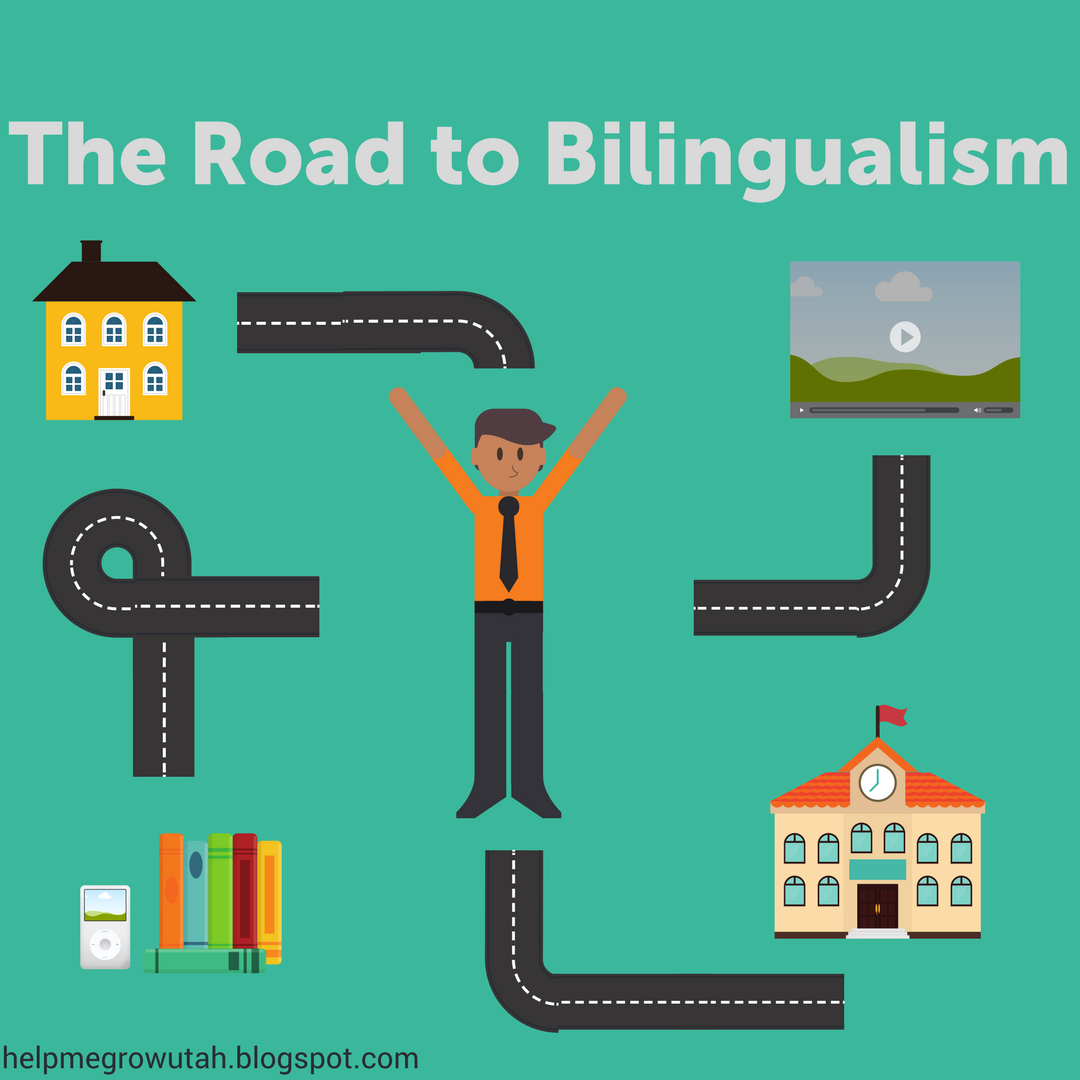
 The percentage of bilingual children in the United States has risen steadily for the past decade, causing families to wonder if it really is worth it to have their child learn another language or if the process is too lengthy and costly. This blog is to inform and help families navigate their way to having their child become bilingual, so families can decide if it is truly worth the effort.

Showing posts with label Cognitive Development. Show all posts
Showing posts with label Cognitive Development. Show all posts
Wednesday, June 13, 2018
The Road to Bilingualism
The percentage of bilingual children in the United States has risen steadily for the past decade, causing families to wonder if it really is worth it to have their child learn another language or if the process is too lengthy and costly. This blog is to inform and help families navigate their way to having their child become bilingual, so families can decide if it is truly worth the effort. 

Wednesday, April 18, 2018
How to Teach Children Honesty


Wednesday, November 8, 2017
Six Ways Infants Learn
 Babies learn differently than adults. Their brains are still
forming and going through the pruning process. Babies are curious and love to
explore their new surroundings. Isn’t it great that as parents you get to be a
part of that exploration? Since you are part of that exploration, it is good to
know how babies learn. Here are six ways infants learn:
Synchrony: this is the give and take between you and your child. Dora the explorer attempts to have synchrony. She asks a question and waits for the child to respond. While the intent is good, synchrony is best achieved in person.
Wednesday, February 1, 2017
5 Important Stages of Literacy

Sometimes kids think that they do not know how to read or write because of their age. However, we know that children are building their literacy skills from the time they are in the womb and it is our job to help them work on these skills.
Friday, July 8, 2016
Make-Believe Play and Your Child's Development

I took a Parenting and Child Guidance class and we read a book by Laura E. Berk called, Awakening Children's Minds: How Parents and Teachers Can Make a Difference. Berk explains in one of the chapters how make-believe play contributes to a child's learning and development. Here are some highlights that I found!
Wednesday, May 25, 2016
Love You Forever
 |
| Amazon |
I’ll love you forever,
I’ll like you for always,
As long as I’m living,
My baby you’ll be
I’ll like you for always,
As long as I’m living,
My baby you’ll be
Wednesday, September 23, 2015
Child Led Play = Learning
This past weekend, I had the opportunity to attend the Southern Utah Early Childhood Collaboration Conference in Cedar City. Denita Dinger was invited to be the guest speaker and she shared a lot of good information about the importance of child-led open ended play. Below is a list of words she shared that is the "Important Stuff" found in play...
What kinds of things do you like to give your kids to play with during open play time?
Asking
|
Discriminating
|
Kicking
|
Pretending
|
Trying
|
Comparing
|
Deciphering
|
Leading
|
Questioning
|
Testing
|
Compromising
|
Exploring
|
Laughing
|
Reasoning
|
Tracking
|
Compassion
|
Expressing
|
Loving
|
Rationing
|
Understanding
|
Control
|
Failing
|
Manipulating
|
Relationships
|
Visualizing
|
Comprehending
|
Grabbing
|
Moving
|
Realizing
|
Volunteering
|
Collaborating
|
Grasping
|
Mimicking
|
Running
|
Walking
|
Causing
|
Giving
|
Observing
|
Rolling
|
Waiting
|
Challenging
|
Hopping
|
Objecting
|
Role Playing
|
Watching
|
Creating
|
Holding
|
Organizing
|
Showing
|
Wondering
|
Climbing
|
Imagining
|
Planning
|
Struggling
|
|
Crawling
|
Investigating
|
Participating
|
Succeeding
|
|
Coordinating
|
Joking
|
Practicing
|
Strengthening
|
|
Discovering
|
Jumping
|
Polishing
|
Solving
|
And there are many more words that could be used to describe children's play! Isn't it amazing all the different things your child can learn through play?
 |
| Photo Credit |
Denita went on to share five tips when it comes to open play:
- Control your Stuff. You must know what stuff you have and where it is so you can grab it at any time. As children are playing and learning, they may ask for something to add to their play that will also expand their learning and you need to know where to find it!
- Plopper! Plopper (noun): Anything that is placed in a child's environment with zero adult direction, demonstration or expectation. Giving your child a new item and allowing them to explore different ways to play with it is a great way for them to learn. Avoid showing them how to use it.
- Stellar Reactor. By allowing your child to lead the play, they will try different "wonder if" techniques. Allow your child to explore and try different methods. By doing so, they learn how to react to problems and conflicts
- Tongue Biter! This is the hardest one for adults. It would be so easy for us to swoop in and solve any problem that comes up. Like said in #2, plop and then step back. Allow your child to discover a method that works for them. Don't try and show them the "correct" way.
- Dissector of Play. Observe your child while they play. Do you see what they are doing? They are learning! Now's the time for you to sit back and enjoy watching your children play.
 |
| Photo Credit |
-Jodi
Friday, August 7, 2015
Talking is Teaching
 My baby recently reached the age where she is starting
to coo and make sounds. The first time she made a throaty little gurgle, I got
so excited! Now, when I get down on her level and talk to her about her day,
she loves to “talk” back to me, no doubt thinking that we are having an actual
conversation. When we bring her around family it is not uncommon for them to mimic
her sounds back to her. Little do they know that through this back and forth
communication, they are helping her develop language skills that will significantly
help her in the future.

Here we learn
that we can teach babies these skills through play. Simple games like
peek-a-boo and singing songs about everyday things the child can see will help
develop their executive function.
Simply talking at your child is not enough. The “conversational duet” is what researchers call the back and forth caregivers use when interacting with children. It is important to talk with your child without interruption. Studies show that language learning doesn’t happen when conversations are interrupted.
The article linked above teaches that
“when parents keep the conversation going, rather than simply trying to get
their children to hear as many words as possible, they are preparing their
children for later language and school success.” It is more important to have
quality interactions than a large quantity of words.
As parents, we do
everything we can to help our children grow and develop. By having meaningful conversations
with our children, no matter their age, and teaching them through every day
interactions we are setting them up for success.
What are some of your
favorite things to talk with your children about?

- Amanda
Monday, March 2, 2015
Oh the Places You'll Go!
Since this week is Dr. Seuss’ birthday, I thought it would be
appropriate to start off with one of his quotes:
 |
| Photo Source |
“The more that you read, the more things you will know. The more that
you learn, the more places you'll go.” – Dr. Seuss
I love to read! Growing up, I remember my mom taking my sisters and I
to the library every week. When I was really little, I’d bring home huge stacks
of picture books with simple stories. As I got older, I’d make space in my
backpack for 10 novels of many different genres (that was as many as the
library would let you check out at a time).
When we got home, I’d snuggle into my favorite corner to read for
hours. I’d visit places all over the world, learn about the people of various
periods in history, and solve challenging mysteries. I learned new vocabulary,
observed challenging interactions between characters, and stretched my
imagination as I experienced each new world.
As a result, school became easier for me, my relationships with family
and friends were enhanced, and my communication skills and vocabulary were
always more advanced than they were expected to be. Now, my taste in books has
changed somewhat, and I don’t find as much time to read as I’d like, but the
difference that a love of reading has had on my life is incredible.
To gain a love of reading later in life, and thus be able to benefit
from reading, it is crucial that parents read to their young children. Why
should you read with your kids? Jim Trelease, author of The New York Times
bestseller, “The Read-Aloud Handbook”, says that “words are the primary
building blocks for learning and there are only two efficient ways to get words
into the brain: either through the eye or through the ear....the last 30 years of reading
research confirms this simple formula: students who read the most, read the
best, achieve the most, and stay in school the longest”.

This March, KUED celebrates 22
years of encouraging reading in Utah, in partnership with schools, libraries,
and museums across the state.
KUED recently kicked off its 22nd Reading Marathon which runs from
March 1st through the 31st. Children
from Pre-K to 6th Grade are encouraged to participate, and read at least 20
minutes a day. Reading logs can also be downloaded or printed from kued.org/reading.
“We encourage parents to spend time reading with their kids, and log
their reading minutes for an invitation to the 22nd Annual Super Reader party
in April,” says KUED Education Coordinator Elise Peterson. “Our theme this year is STEAM: Science,
Technology, Engineering, Art, and Math. To see pictures from previous years,
visit our Facebook page at facebook.com/kuedkids.”
“For over 50 years KUED and PBS have been a friendly and trusted face
in your home and we hope to build on that relationship with new resources,
information, and events for your family that engage, educate, and entertain,”
says Peterson.
Find out more at kued.org/reading and visit the KUED Kids Facebookpage, for information about events, programs, and ideas for families.
So, what are you waiting for!?
"You're never too old, too wacky, too wild, to pick up a book and
read to a child." – Dr. Seuss
Tuesday, November 4, 2014
Developmental Leaps
 |
| Photo Credit |
GOOD NEWS PARENTS!! We might not be doing anything wrong and there might not be anything wrong with our baby. Child development researchers have described these fussy phases as a signal of great and drastic changes in a baby’s mental development. "During these times, his brain is giving him new possibilities. So many possibilities, in fact, that the world around him seems totally different and new. No wonder he is fussy! He needs to get a grip on this ‘new world’ suddenly in front of him. As a result, he acts out and becomes more Clingy, Cranky and Cries more" (The Wonder Weeks).
 |
| Photo Credit |
Many professionals call these changes in a baby's mental
development "Developmental Leaps." Other professionals might call
them "Touchpoints." Either way the definition for both is the same:
Predictable periods of time during a child’s development where a child will “leap” from one skill (e.g. motor, cognitive, or emotional skills) to a more difficult skill. During this “leap,” or period of rapid growth, a child’s behavior falls apart, they go into a state of neurological disorganization, and the previous skills they had achieved can be shelved for a while as they are focusing keenly on achieving the new and more difficult skill. “Every time a baby goes through a leap they perceive things they couldn't do before. It’s like the whole world around them changes” (Ask the experts: Baby leaps).
 |
| Photo Credit |
One example of a Developmental Leap can be seen in a four month
old baby as he or she goes through a burst in cognitive awareness of his or her
environment. "The baby will be difficult to feed. He will stop eating to
look around and to listen to every stimulus in the environment. To parents’
dismay, he will begin to awaken again at night. His awareness of his
surroundings will be enhanced by a burst in visual development. Yet, [as
parents], when [we] understand the disorganization of this period as a natural
precursor to the rapid and exciting development that follows, [we] will not need
to feel as if it represents failure" (Touchpoints, 2003).
Understanding that Developmental Leaps could be a possible reason for our child's behavior or development can help us navigate through these predictable spurts and the issues that these spurts may raise in our families. Dr. T. Berry Brazelton, M.D., the author of Touchpoints: The Essential Reference--Your Child's Emotional and Behavioral Development , pointed out in his book that "Each [leap] accomplished leads to a new sense of autonomy. When seen as normal and predictable, these periods of regressive behavior are opportunities to understand the child more deeply and to support his or her growth, rather than to become locked into a struggle. A child’s particular strengths and vulnerabilities, as well as temperament and coping style, all come to the surface at such a time. What a chance for understanding the child as an individual!” (p. xvii-xviii).
Understanding that Developmental Leaps could be a possible reason for our child's behavior or development can help us navigate through these predictable spurts and the issues that these spurts may raise in our families. Dr. T. Berry Brazelton, M.D., the author of Touchpoints: The Essential Reference--Your Child's Emotional and Behavioral Development , pointed out in his book that "Each [leap] accomplished leads to a new sense of autonomy. When seen as normal and predictable, these periods of regressive behavior are opportunities to understand the child more deeply and to support his or her growth, rather than to become locked into a struggle. A child’s particular strengths and vulnerabilities, as well as temperament and coping style, all come to the surface at such a time. What a chance for understanding the child as an individual!” (p. xvii-xviii).
Some common signs that your child might be going through a
Developmental Leap include:
- eating less
- sleeping less or waking up a lot of the time
- digressing in his/her development instead of forward
- crying more
- being cranky
- clinging to you all the time
- being ill more often
- not being satisfied no matter what you do
Recognizing Developmental Leap periods is a great resource of
knowledge that can help us navigate through our child's development. Raising a child is hard, but equipping ourselves with the knowledge that will better
help us understand our child's development may save us from many unneeded
hardships.
Have you noticed any Developmental Leap periods your child has
gone through or maybe is going through?
Tuesday, September 30, 2014
The Effects of Trauma on Infant Development
Thank you to our Guest Blogger Dr. Karen W Malm, PhD., Licensed Psychologist, for contributing this post!
I
can remember when I started working with preschoolers back in the early 1980's and
the general belief of the psychiatric community was that trauma or abuse in
children that young had no real long-term effects. Children could get over
those issues readily and could move forward. Infant mental health did not even
exist and the concept that an infant would have mental health issues was
far-fetched. When Lenore Terr wrote her groundbreaking book in 1992, Too Scared to Cry, she described how
psychic trauma affects young children across the lifespan. With the discoveries
in the neurosciences, we can now look at how infant brain development is
impacted by learning and experience and can see how trauma can impact infants
and their long term mental health.
 We
know infants are not passively experiencing their world, but their neurons are
actively making connections and growing into neural pathways. When an infant
cries and is upset, he or she is trying to communicate a need for help. In a
calm mother with good parenting skills, she takes the infant and swaddles him
or her closely which helps control his or her limbs over which the infant has no
motor control. Then she holds him or her close to her chest where her calm
heart beat can help calm the baby’s heart rate and her steady breathing can
help calm the baby’s breathing, and her soft words tell the baby, “shh, there,
there, you’ll be fine.” This experience goes right to his or her brain and the
neural connections to learn self-calming are made.

As adults, when we hit our head, somewhere in our brains is that soft voice, “shh, there, there,” which triggers our ability to self-calm. In a home with trauma, such as with domestic violence, the mother is not able to engage in these self-calming behaviors. Her own heart rate might be beating rapidly, her breath might be shallow and rapid, and she is struggling to keep her composure and is unable to calm the infant. The infant not only does not get calmed, but also may get more stimulated and the neurons get short-circuited with over-stimulation. Replay this scene multiple times and those neurons for regulating emotions get short-circuited as well. Infants in these trauma environments end up with difficulty sleeping, feeding problems, and are hard to soothe. They may have difficulty with eye to eye gazing and being comforted by others. With neural networking, we can see that with ongoing reinforcement of these neural pathways, an infant could “learn” these habits. This would case long-term mental health issues and difficulty with regulating emotions later in life.
As
mental health experts in the field of infant mental health, our interventions
involve re-teaching these self-calming skills. This involves working with the
mother and helping her learn how to be a calming person who can provide safety
and nurturing to her infant. She needs to learn to use her own calm body to
provide a model for her infant’s sensory system and developing brain. By making
new neural connections, the infant can start the process of learning to
self-regulate and self-calm; a healthy step towards positive mental health.
Here is a great video to supplement this article!
Here is a great video to supplement this article!
Thursday, June 19, 2014
Packing Peanut Pool and Other Fine Motor Activities
Looking for simple and entertaining options for kids this summer? Want activities to assist in the development of fine motor skills? Here are a few ideas for you!
Swimming In Packing Peanuts
 Want a drier option for your swimming pool? Fill a plastic toddler swimming pool with biodegradable packing peanuts (found at Walmart, Target or online). Prices vary by amount and size of the package. These are non toxic, not a choking hazard and not staticy (making clean up much easier!) They look like white cheese puffs so don't be too surprised when your child puts them in their mouth expecting something tasty. Place beach toys or kitchen utensils in the pool as well. Feel free to hid items in the pool as well. Watch your child pick up peanuts with large spoons or shovels. Feel free to join in the fun (we have!!) you won't regret the giggles created from a foam peanut fight! This will help in their fine motor development and sensory awareness.
Foam Blocks
Foam blocks allow children to build or put pieces together. Due to their softness they pose no danger of injury if they are (inevitably) thrown or if they fall on your child. These can be purchased in a number of different places such as Walmart or Target. Price usually ranges between $20-$40 depending on how many come in the pack. Show your child how to use the blocks in the following ways: carrying, sorting by shapes and colors, stacking, knocking down and cleaning up. This play will assist in problem solving, fine motor development and identifying shapes and colors.
Homemade Cardboard Blocks
You can buy cardboard blocks which tend to be larger (great for building larger forts). Expect them to be flat and need folding and assembling. OR you could save all those CapriSun boxes over the weeks, tape them shut, color or cover them with construction paper and go to town! With these blocks you can do many of the same activities as the foam blocks. These will also help with spacial awareness and cause and effect as you build and knock them down.
Swimming In Packing Peanuts
Foam blocks allow children to build or put pieces together. Due to their softness they pose no danger of injury if they are (inevitably) thrown or if they fall on your child. These can be purchased in a number of different places such as Walmart or Target. Price usually ranges between $20-$40 depending on how many come in the pack. Show your child how to use the blocks in the following ways: carrying, sorting by shapes and colors, stacking, knocking down and cleaning up. This play will assist in problem solving, fine motor development and identifying shapes and colors.
Homemade Cardboard Blocks
You can buy cardboard blocks which tend to be larger (great for building larger forts). Expect them to be flat and need folding and assembling. OR you could save all those CapriSun boxes over the weeks, tape them shut, color or cover them with construction paper and go to town! With these blocks you can do many of the same activities as the foam blocks. These will also help with spacial awareness and cause and effect as you build and knock them down.
Tuesday, June 10, 2014
Play Time: What's the Big Deal?
Sure play time is fun, but did you know there is more to
play time than just keeping your kids busy? “What do you mean?” “It’s not just
something fun to do?!” Well of course it is, but it is also a very important
tool in the development of your little troublemaker.

Play is the way babies find out about themselves and the
world around them.
When babies play they use all five senses to learn about the
new things around them, especially in the first year! Your baby is always
asking questions about the world like, “What does this feel like when I touch
it?” “What does this sound like when I squeeze it?” “What will happen if I push
this or pull that?” etc.
Though you don’t actually hear the questions, as parents you
do see the results; toys flying here, food spilling there!

Saying that play time helps development is great, but you
want to know how? Well, I’ll tell you!
Play promotes
sociomoral growth as children:
·
Practice social roles.
·
Learn to take perspective of others.
·
Participate in turn taking, cooperation, and
sharing.
·
Develop empathy and deal with issues of fairness
and rule making/following.
·
Work through conflict with increasing
flexibility.
·
Experience sheer fun – the positive aspect of
fun is that it is essential to growth and a strong motivation for every kind of
learning.
Play promotes cognitive
development as children:
·
Change oneself into some object, person, or
situation.
·
Combine and practice concepts they have already
assimilated.
·
Use and rehearse new skills by putting together
thinking skills in new ways to fit the play situation.
·
Learn new ideas from peers.
·
Share and communicated thoughts through roles
they assume.
·
Increase problem solving ability (Sylva, Bruner,
Genova, 1976).
Play promotes
literacy and language development as children:
·
Use communicative (access rituals, topic development
and maintenance, turn-taking, negotiation, etc.) skills.
·
Reconstruct events and sequences in
events/stories thus leading to increased story comprehension (Pellegrini and
Galdi, 1982).
·
Rely on language to organize and structure their
play.
·
Practice new vocabulary by connecting words and
images with a context.
Play promotes
physical development as children:
·
Coordinate their actions with the actions of
objects and other people.
·
Engage in activities that develop stamina,
flexibility, strength, coordination, and fitness.
·
Practice gross and fine motor skills.
Yes, play is good for your children but don’t forget that play is for parents too. That’s right, play is for you! Play is a time
to enjoy with your baby and get to know them as they get to know you.
Play is important but don’t forget that it is also very fun
and can be very easy to do! Here are five simple activities to help you get
started:
Play peek-a-boo: little kids
love this game and it is so easy to do!
Read a book: Let your child
explore the book
Spend time face to face with baby:
Imitate baby’s faces and sounds and let them imitate back
Build a fort: This one is
great for older children, and all you need is what you can find around the
house!
Pots and pans: This lets your
baby explore sound!
What fun things do you do to play with your child?
This information came from handouts from Help Me Grow. Call us
if you would like to know more!


Thursday, May 22, 2014
Why I Love the ASQ!
One
of my favorite FREE Help Me Grow services is receiving the Ages & Stages
Questionnaire (ASQ), a tool you can use to track your child’s development! The
ASQ is available from birth until age five and a half. Here are some of my
reasons why I love the ASQ!
| Photo Credit |
1. Let’s talk
kindergarten readiness. Did you know that families
who complete an ASQ at least once per year are more likely to have a child who thrives
in kindergarten? Less than 50% of children with delays have had them addressed
before kindergarten. And keep in mind that some delays are visible or readily
apparent, while some are less so. The ASQ can help identify both. That alone
makes the ASQ worth taking…and worth taking more than once.
2. The ASQ is a friendly questionnaire that helps you identify & celebrate your child’s strengths. Your child is unique, and lucky for you, the ASQ will help identify your child’s strengths. Completing the ASQ should be fun. Remember to celebrate your child’s success no matter how big or small it may be.
3. On the flip-side, the ASQ may
ask a question that you just hadn’t thought of trying with your child. These
types of questions prompt you to try something new with your child! Ask your care coordinator
to send you supplemental developmental activities to continue to strengthen
your child’s development.
4. But honestly my favorite
part… the ASQ pinpoints areas you can discuss with your doctor. I don’t know about you, but
I HATE going to the doctor and being sent on my way a few minutes later without
having time to formulate questions I would like to ask.
5. Baby journaling. Alright for
those of you who are big journal writers, you can put a copy of the ASQ in your
baby’s journal to highlight developmental milestones. Admit
it, we’ve all looked back on the baby books our parents did for us and oohed
and aahed at the milestones our parents recorded for us… or worse, the empty
blanks our busy parents never recorded. Add the ASQ into the journal as a
supplement or go ahead and just add the ASQ in there and call it good.
6. The ASQ is an evidence-based
tool. For
the nerd in me, this is important to me for valid results. A ton of research
and testing went into the ASQ. The ASQ asks questions that are sensitive enough
to pick up on developmental issues that your child may need more support with.
The
ASQ is a great tool to monitor your child’s development. It highlights your
child’s strengths and can also identify areas of concern. If you do have any concerns,
Help Me Grow can send you information, answer tough parenting questions, and
help you connect with local community resources.
Subscribe to:
Posts (Atom)